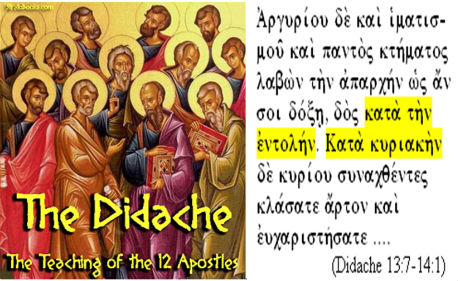
The Didache or Teaching of the Twelve Apostles
Translated by Charles H. Hoole
CHAPTER 1
1:1 There are two paths, one of life and one of death, and the difference is great between the two paths.
1:2 Now the path of life is this -- first, thou shalt love the God who made thee, thy neighbour as thyself, and all things that thou wouldest not should be done unto thee, do not thou unto another.
1:3 And the doctrine of these maxims is as follows. Bless them that curse you, and pray for your enemies. Fast on behalf of those that persecute you; for what thank is there if ye love them that love you? Do not even the Gentiles do the same? But do ye love them that hate you, and ye will not have an enemy.
1:4 Abstain from fleshly and worldly lusts. If any one give thee a blow on thy right cheek, turn unto him the other also, and thou shalt be perfect; if any one compel thee to go a mile, go with him two; if a man take away thy cloak, give him thy coat also; if a man take from thee what is thine, ask not for it again, for neither art thou able to do so.
1:5 Give to every one that asketh of thee, and ask not again; for the Father wishes that from his own gifts there should be given to all. Blessed is he who giveth according to the commandment, for he is free from guilt; but woe unto him that receiveth. For if a man receive being in need, he shall be free from guilt; but he who receiveth when not in need, shall pay a penalty as to why he received and for what purpose; and when he is in tribulation he shall be examined concerning the things that he has done, and shall not depart thence until he has paid the last farthing.
1:6 For of a truth it has been said on these matters, let thy almsgiving abide in thy hands until thou knowest to whom thou hast given.
CHAPTER 2
2:1 But the second commandment of the teaching is this.
2:2 Thou shalt not kill; thou shalt not commit adultery; thou shalt not corrupt youth; thou shalt not commit fornication; thou shalt not steal; thou shalt not use soothsaying; thou shalt not practise sorcery; thou shalt not kill a child by abortion, neither shalt thou slay it when born; thou shalt not covet the goods of thy neighbour;
2:3 thou shalt not commit perjury; thou shalt not bear false witness; thou shalt not speak evil; thou shalt not bear malice;
2:4 thou shalt not be double-minded or double-tongued, for to be double tongued is the snare of death.
2:5 Thy speech shall not be false or empty, but concerned with action.
2:6 Thou shalt not be covetous, or rapacious, or hypocritical, or malicious, or proud; thou shalt not take up an evil design against thy neighbour;
2:7 thou shalt not hate any man, but some thou shalt confute, concerning some thou shalt pray, and some thou shalt love beyond thine own soul.
CHAPTER 3
3:1 My child, fly from everything that is evil, and from everything that is like to it.
3:2 Be not wrathful, for wrath leadeth unto slaughter; be not jealous, or contentious, or quarrelsome, for from all these things slaughter ensues.
3:3 My child, be not lustful, for lust leadeth unto fornication; be not a filthy talker; be not a lifter up of the eye, for from all these things come adulteries.
3:4 My child, be not an observer of omens, since it leadeth to idolatry, nor a user of spells, nor an astrologer, nor a travelling purifier, nor wish to see these things, for from all these things idolatry ariseth.
3:5 My child, be not a liar, for lying leadeth unto theft; be not covetous or conceited, for from all these things thefts arise.
3:6 My child, be not a murmurer, since it leadeth unto blasphemy; be not self-willed or evil-minded, for from all these things blasphemies are produced;
3:7 but be thou meek, for the meek shall inherit the earth;
3:8 be thou longsuffering, and compassionate, and harmless, and peaceable, and good, and fearing alway the words that thou hast heard.
3:9 Thou shalt not exalt thyself, neither shalt thou put boldness into thy soul. Thy soul shall not be joined unto the lofty, but thou shalt walk with the just and humble.
3:10 Accept the things that happen to thee as good, knowing that without God nothing happens.
CHAPTER 4
4:1 My child, thou shalt remember both night and day him that speaketh unto thee the Word of God; thou shalt honour him as thou dost the Lord, for where the teaching of the Lord is given, there is the Lord;
4:2 thou shalt seek out day by day the favour of the saints, that thou mayest rest in their words;
4:3 thou shalt not desire schism, but shalt set at peace them that contend; thou shalt judge righteously; thou shalt not accept the person of any one to convict him of transgression;
4:4 thou shalt not doubt whether a thing shall be or not.
4:5 Be not a stretcher out of thy hand to receive, and a drawer of it back in giving.
4:6 If thou hast, give by means of thy hands a redemption for thy sins.
4:7 Thou shalt not doubt to give, neither shalt thou murmur when giving; for thou shouldest know who is the fair recompenser of the reward.
4:8 Thou shalt not turn away from him that is in need, but shalt share with thy brother in all things, and shalt not say that things are thine own; for if ye are partners in what is immortal, how much more in what is mortal?
4:9 Thou shalt not remove thine heart from thy son or from thy daughter, but from their youth shalt teach them the fear of God.
4:10 Thou shalt not command with bitterness thy servant or thy handmaid, who hope in the same God as thyself, lest they fear not in consequence the God who is over both; for he cometh not to call with respect of persons, but those whom the Spirit hath prepared.
4:11 And do ye servants submit yourselves to your masters with reverence and fear, as being the type of God.
4:12 Thou shalt hate all hypocrisy and everything that is not pleasing to God;
4:13 thou shalt not abandon the commandments of the Lord, but shalt guard that which thou hast received, neither adding thereto nor taking therefrom;
4:14 thou shalt confess thy transgressions in the Church, and shalt not come unto prayer with an evil conscience. This is the path of life.
CHAPTER 5
5:1 But the path of death is this. First of all, it is evil, and full of cursing; there are found murders, adulteries, lusts, fornication, thefts, idolatries, soothsaying, sorceries, robberies, false witnessings, hypocrisies, double-mindedness, craft, pride, malice, self-will, covetousness, filthy talking, jealousy, audacity, pride, arrogance;
5:2 there are they who persecute the good -- lovers of a lie, not knowing the reward of righteousness, not cleaving to the good nor to righteous judgment, watching not for the good but for the bad, from whom meekness and patience are afar off, loving things that are vain, following after recompense, having no compassion on the needy, nor labouring for him that is in trouble, not knowing him that made them, murderers of children, corrupters of the image of God, who turn away from him that is in need, who oppress him that is in trouble, unjust judges of the poor, erring in all things. From all these, children, may ye be delivered.
CHAPTER 6
6:1 See that no one make thee to err from this path of doctrine, since he who doeth so teacheth thee apart from God.
6:2 If thou art able to bear the whole yoke of the Lord, thou wilt be perfect; but if thou art not able, what thou art able, that do.
6:3 But concerning meat, bear that which thou art able to do. But keep with care from things sacrificed to idols, for it is the worship of the infernal deities.
CHAPTER 7
7:1 But concerning baptism, thus baptize ye: having first recited all these precepts, baptize in the name of the Father, and of the Son, and of the Holy Spirit, in running water;
7:2 but if thou hast not running water, baptize in some other water, and if thou canst not baptize in cold, in warm water;
7:3 but if thou hast neither, pour water three times on the head, in the name of the Father, and of the Son, and of the Holy Spirit.
7:4 But before the baptism, let him who baptizeth and him who is baptized fast previously, and any others who may be able. And thou shalt command him who is baptized to fast one or two days before.
CHAPTER 8
8:1 But as for your fasts, let them not be with the hypocrites, for they fast on the second and fifth days of the week, but do ye fast on the fourth and sixth days.
8:2 Neither pray ye as the hypocrites, but as the Lord hath commanded in his gospel so pray ye: Our Father in heaven, hallowed be thy name. Thy kingdom come. Thy will be done as in heaven so on earth. Give us this day our daily bread. And forgive us our debt, as we also forgive our debtors. And lead us not into temptation, but deliver us from the evil: for thine is the power, and the glory, for ever.
8:3 Thrice a day pray ye in this fashion.
CHAPTER 9
9:1 But concerning the Eucharist, after this fashion give ye thanks.
9:2 First, concerning the cup. We thank thee, our Father, for the holy vine, David thy Son, which thou hast made known unto us through Jesus Christ thy Son; to thee be the glory for ever.
9:3 And concerning the broken bread. We thank thee, our Father, for the life and knowledge which thou hast made known unto us through Jesus thy Son; to thee be the glory for ever.
9:4 As this broken bread was once scattered on the mountains, and after it had been brought together became one, so may thy Church be gathered together from the ends of the earth unto thy kingdom; for thine is the glory, and the power, through Jesus Christ, for ever.
9:5 And let none eat or drink of your Eucharist but such as have been baptized into the name of the Lord, for of a truth the Lord hath said concerning this, Give not that which is holy unto dogs.
CHAPTER 10
10:1 But after it has been completed, so pray ye.
10:2 We thank thee, holy Father, for thy holy name, which thou hast caused to dwell in our hearts, and for the knowledge and faith and immortality which thou hast made known unto us through Jesus thy Son; to thee be the glory for ever.
10:3 Thou, Almighty Master, didst create all things for the sake of thy name, and hast given both meat and drink, for men to enjoy, that we might give thanks unto thee, but to us thou hast given spiritual meat and drink, and life everlasting, through thy Son.
10:4 Above all, we thank thee that thou art able to save; to thee be the glory for ever.
10:5 Remember, Lord, thy Church, to redeem it from every evil, and to perfect it in thy love, and gather it together from the four winds, even that which has been sanctified for thy kingdom which thou hast prepared for it; for thine is the kingdom and the glory for ever.
10:6 Let grace come, and let this world pass away. Hosanna to the Son of David. If any one is holy let him come (to the Eucharist); if any one is not, let him repent. Maranatha. Amen.
10:7 But charge the prophets to give thanks, so far as they are willing to do so.
CHAPTER 11
11:1 Whosoever, therefore, shall come and teach you all these things aforesaid, him do ye receive;
11:2 but if the teacher himself turn and teach another doctrine with a view to subvert you, hearken not to him; but if he come to add to your righteousness, and the knowledge of the Lord, receive him as the Lord.
11:3 But concerning the apostles and prophets, thus do ye according to the doctrine of the Gospel.
11:4 Let every apostle who cometh unto you be received as the Lord.
11:5 He will remain one day, and if it be necessary, a second; but if he remain three days, he is a false prophet.
11:6 And let the apostle when departing take nothing but bread until he arrive at his resting-place; but if he ask for money, he is a false prophet.
11:7 And ye shall not tempt or dispute with any prophet who speaketh in the spirit; for every sin shall be forgiven, but this sin shall not be forgiven.
11:8 But not every one who speaketh in the spirit is a prophet, but he is so who hath the disposition of the Lord; by their dispositions they therefore shall be known, the false prophet and the prophet.
11:9 And every prophet who ordereth in the spirit that a table shall be laid, shall not eat of it himself, but if he do otherwise, he is a false prophet;
11:10 and every prophet who teacheth the truth, if he do not what he teacheth is a false prophet;
11:11 and every prophet who is approved and true, and ministering in the visible mystery of the Church, but who teacheth not others to do the things that he doth himself, shall not be judged of you, for with God lieth his judgment, for in this manner also did the ancient prophets.
11:12 But whoever shall say in the spirit, Give me money, or things of that kind, listen not to him; but if he tell you concerning others that are in need that ye should give unto them, let no one judge him.
CHAPTER 12
12:1 Let every one that cometh in the name of the Lord be received, but afterwards ye shall examine him and know his character, for ye have knowledge both of good and evil.
12:2 If the person who cometh be a wayfarer, assist him so far as ye are able; but he will not remain with you more than two or three days, unless there be a necessity.
12:3 But if he wish to settle with you, being a craftsman, let him work, and so eat;
12:4 but if he know not any craft, provide ye according to you own discretion, that a Christian may not live idle among you;
12:5 but if he be not willing to do so, he is a trafficker in Christ. From such keep aloof.
CHAPTER 13
13:1 But every true prophet who is willing to dwell among you is worthy of his meat,
13:2 likewise a true teacher is himself worthy of his meat, even as is a labourer.
13:3 Thou shalt, therefore, take the firstfruits of every produce of the wine-press and threshing-floor, of oxen and sheep, and shalt give it to the prophets, for they are your chief priests;
13:4 but if ye have not a prophet, give it unto the poor.
13:5 If thou makest a feast, take and give the firstfruits according to the commandment;
13:6 in like manner when thou openest a jar of wine or of oil, take the firstfruits and give it to the prophets;
13:7 take also the firstfruits of money, of clothes, and of every possession, as it shall seem good unto thee, and give it according to the commandment.
CHAPTER 14
14:1 But on the Lord's day, after that ye have assembled together, break bread and give thanks, having in addition confessed your sins, that your sacrifice may be pure.
14:2 But let not any one who hath a quarrel with his companion join with you, until they be reconciled, that your sacrifice may not be polluted,
14:3 for it is that which is spoken of by the Lord. In every place and time offer unto me a pure sacrifice, for I am a great King, saith the Lord, and my name is wonderful among the Gentiles.
CHAPTER 15
15:1 Elect, therefore, for yourselves bishops and deacons worthy of the Lord, men who are meek and not covetous, and true and approved, for they perform for you the service of prophets and teachers.
15:2 Do not, therefore, despise them, for they are those who are honoured among you, together with the prophets and teachers.
15:3 Rebuke one another, not in wrath but peaceably, as ye have commandment in the Gospel; and, but let no one speak to any one who walketh disorderly with regard to his neighbour, neither let him be heard by you until he repent.
15:4 But your prayers and your almsgivings and all your deeds so do, as ye have commandment in the Gospel of our Lord.
CHAPTER 16
16:1 Watch concerning your life; let not your lamps be quenched or your loins be loosed, but be ye ready, for ye know not the hour at which our Lord cometh.
16:2 But be ye gathered together frequently, seeking what is suitable for your souls; for the whole time of your faith shall profit you not, unless ye be found perfect in the last time.
16:3 For in the last days false prophets and seducers shall be multiplied, and the sheep shall be turned into wolves, and love shall be turned into hate;
16:4 and because iniquity aboundeth they shall hate each other, and persecute each other, and deliver each other up; and then shall the Deceiver of the world appear as the Son of God, and shall do signs and wonders, and the earth shall be delivered into his hands; and he shall do unlawful things, such as have never happened since the beginning of the world.
16:5 Then shall the creation of man come to the fiery trial of proof, and many shall be offended and shall perish; but they who remain in their faith shall be saved by the rock of offence itself.
16:6 And then shall appear the signs of the truth; first the sign of the appearance in heaven, then the sign of the sound of the trumpet, and thirdly the resurrection of the dead
16:7 -- not of all, but as it has been said, The Lord shall come and all his saints with him;
16:8 then shall the world behold the Lord coming on the clouds of heaven.